
Stressed Skin? Here’s What It’s Telling You – and How to Heal It

Stressed skin is one of the most common concerns I see at Micromoon. And it is also one of the most misunderstood.
Most people come in thinking they have a product problem. They have tried every serum, every routine, every trending ingredient. Nothing is working. Their skin is breaking out, or inflamed, or suddenly sensitive when it never used to be.
What they actually have is a nervous system problem showing up on their face.
That distinction changes everything about how we treat it.
What Stressed Skin Actually Is
Your skin and your nervous system are not separate systems. They are in constant communication.
When you experience stress – emotional, physical, or environmental – your body releases cortisol. Cortisol is your primary stress hormone, and it does not stay in your bloodstream. It reaches your skin directly.
What cortisol does to your skin:
- Increases sebum production – which leads to congestion and breakouts
- Triggers inflammation – which worsens acne, redness, and sensitivity
- Breaks down collagen – which accelerates the appearance of fine lines
- Compromises your skin barrier – which makes everything more reactive
This is why stressed skin does not respond to products the way healthy skin does. You can apply the most clinical, expensive serum in the world and your skin will not absorb or respond to it properly if your barrier is compromised and your cortisol is elevated.
The product is not the problem. The state your skin is in is the problem.
The 4-Week Lag Nobody Talks About
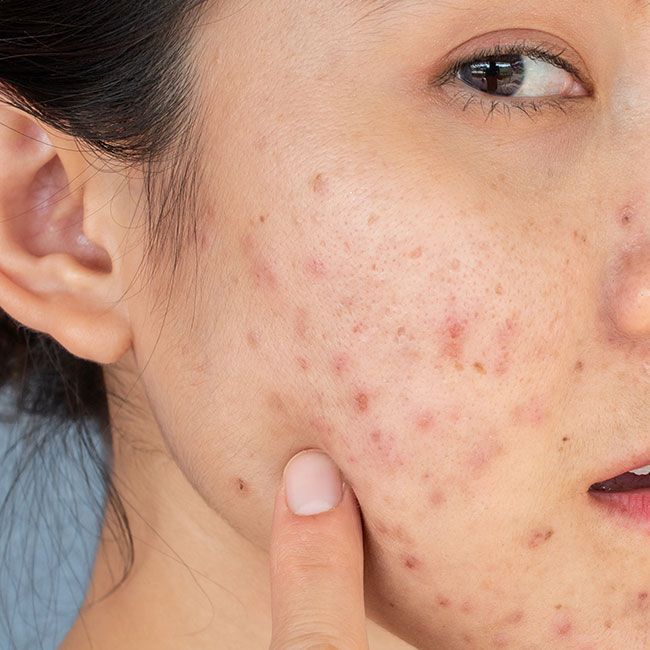
One of the most important things I tell my clients is this: the breakout you are experiencing today is not from what happened today.
The stress-to-skin cycle has a delay of approximately two to four weeks. The cortisol spike from a difficult month at work, a relationship rupture, a period of poor sleep — that shows up on your skin four weeks later.
This is why most people cannot identify the trigger for their breakouts. They are not looking back far enough.
When you understand this delay it completely reframes how you track your skin. It stops being random. It starts being readable.
What Your Stressed Skin Is Trying to Tell You
I spent years working as a counselor before I became an esthetician. What I learned in that work is that the body keeps a record of everything the mind tries to move past.
Stressed skin is not a cosmetic problem. It is your body’s way of communicating that something deeper needs attention.
Different stress presentations show up differently on the skin:
Breakouts along the jawline and chin are almost always hormonal – often linked to cortisol disrupting your androgen balance. This is extremely common in women navigating high-pressure work environments, relationship stress, or major life transitions.
Sudden sensitivity and redness often indicate that your nervous system is in a prolonged state of activation. Your skin barrier has thinned because cortisol has been suppressing its repair cycle. Everything feels like too much because your skin genuinely cannot regulate the way it should.
Dull, flat, lifeless skin is frequently a sign of chronic low-grade stress or exhaustion. Your skin’s cell turnover slows. Circulation decreases. The glow that comes from a regulated, well-rested nervous system simply disappears.
Persistent congestion that does not clear despite a clean routine often points to elevated sebum production combined with a compromised barrier – a combination that creates the perfect environment for congestion to build faster than your skin can clear it.
Why Products Alone Will Never Fix Stressed Skin
I want to be honest with you about something.
If your skin is in a stressed state – barrier compromised, cortisol elevated, microbiome disrupted – the most clinical products in the world will only take you so far.
This is not a reason to stop using good products. Environ, Hydrinity, and the protocols we use at Micromoon are genuinely some of the most effective clinical skincare available. They matter.
But they work best when your skin is in a state that can receive them.
Think of it this way. If you are trying to fill a bucket that has holes in it, the answer is not more water. The answer is to repair the bucket first.
Healing stressed skin requires a two-track approach – clinical treatment that addresses what is happening on the surface, and genuine attention to what is happening underneath.
How We Treat Stressed Skin at Micromoon
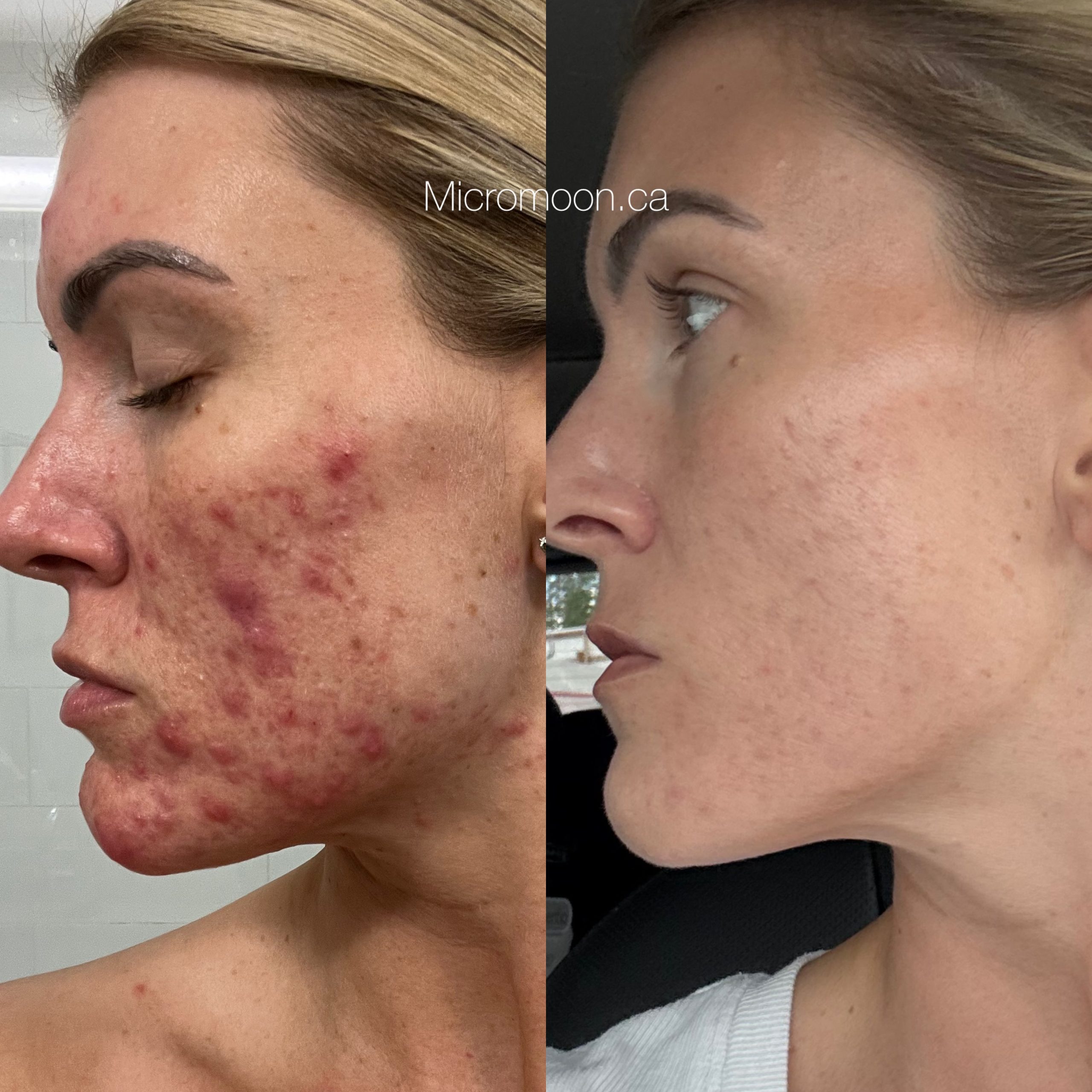
The Micromoon Method was built specifically for this.
When a client comes in with stressed skin, we do not start by throwing actives at it. We start by assessing the whole picture — what is happening in your life, what your skin barrier looks like, what your current routine is doing to help or harm the situation.
From there we build a protocol that works in phases.
The first phase is always about calming and restoring. We use treatments and products that reduce inflammation, support the microbiome, and begin rebuilding the barrier. This is not glamorous work but it is the most important work. Nothing else functions properly until this foundation is in place.
As the skin stabilizes we move into treating the specific concerns – the pigmentation, the texture, the congestion – with clinical precision.
The result is skin that does not just look better for a week after a facial. It actually changes, at a cellular level, because we addressed the conditions that were preventing it from functioning properly.
What You Can Do Right Now
If you are reading this and recognizing your own skin in these descriptions, here are the most important things you can do right now.
Stop changing your products. Product-hopping during a stressed skin phase introduces new variables and further disrupts your barrier. Simplify instead of adding.
Prioritize your barrier. A simple barrier-supporting routine – a gentle cleanser, a barrier repair moisturizer, SPF – done consistently is more effective than a complex ten-step routine during a stress response.
Track your stress alongside your skin. Start noting what is happening in your life four weeks before a breakout cycle. The pattern will become clear quickly.
Book a proper consultation. Not a facial that starts with a quick look at your skin and moves straight into treatment. A real conversation about your skin, your stress, your history, and your goals. That conversation is where real change begins.
At Micromoon, our consultations are the foundation of everything we do. They are where we figure out what your skin is actually responding to – not just what it looks like on the surface.
A Final Thought
Your skin is not failing you. It is communicating with you.
The breakouts, the sensitivity, the inflammation — these are not random. They are a signal from a system that is working exactly as it was designed to, trying to tell you something your mind may have moved past.
You do not need to fix your skin. You need to understand it.
That is what we do at Micromoon.